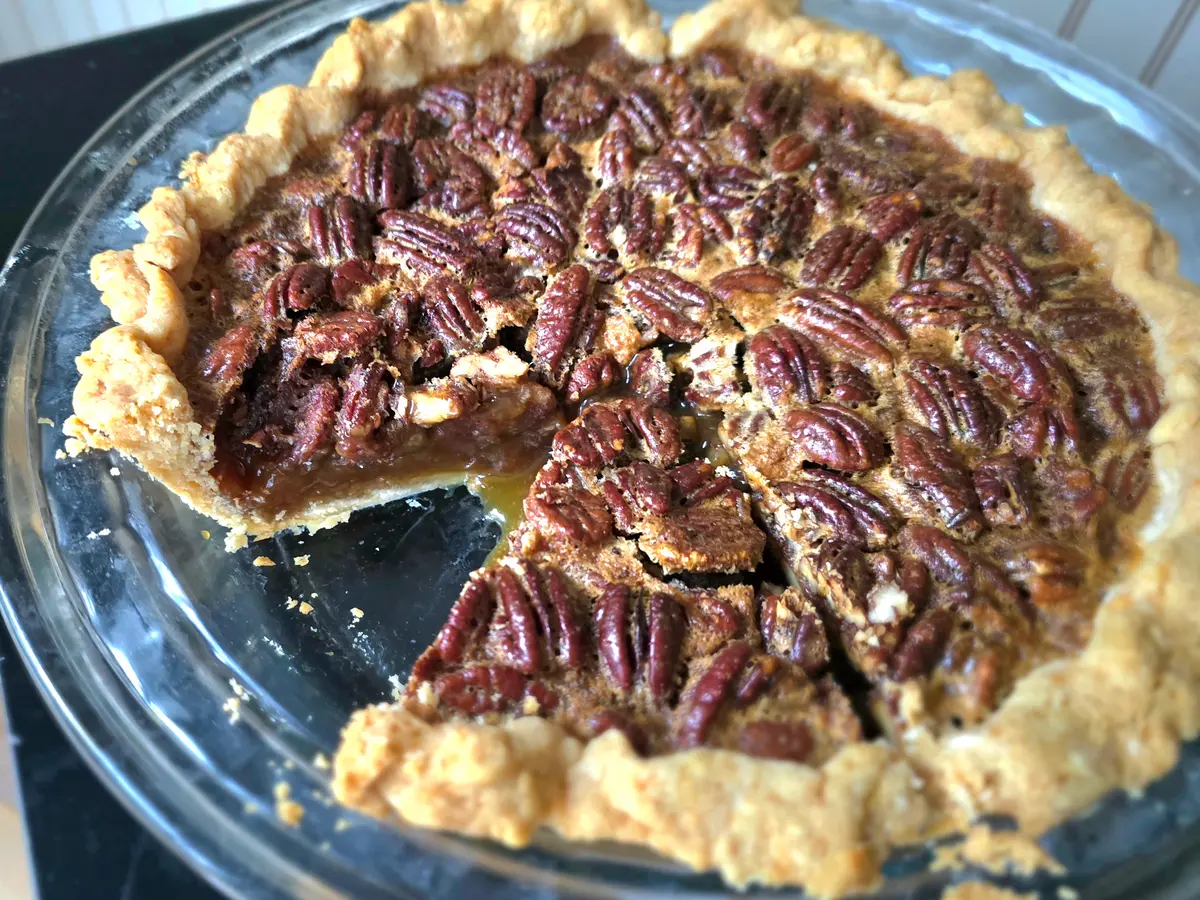
The Best Pie – Pecan Pie – A Classic with Elevated Variations
This is the best pecan pie you'll ever bake—a classic Southern-inspired dessert made more refined with brown butter, espresso, bourbon, and smoked salt. A balanced, less-sweet filling and a perfectly baked crust create an unforgettable pie loved by both adults and kids.
The Darker Pie
There are desserts you inherit before you ever make them.
They enter your life first as atmosphere: the smell of butter in a warm kitchen, the sight of a pie cooling somewhere out of reach, the low thrill of knowing that something serious is waiting at the end of the meal. Pecan pie was like that for me. Before I understood ratios or custards or the fine line between set and overbaked, I understood that pecan pie belonged to a darker category of dessert. Not dark in color alone, though it had that too, but dark in mood. It was not cheerful in the way of lemon bars, not flirtatious like strawberry shortcake, not innocent like vanilla cake. It was deeper than that. More autumnal. More adult. A dessert with shadows in it.
Even as a child, I knew it.
I knew it from the scent alone—that smell of toasted nuts, hot sugar, butter, and something almost bitter at the edges, something that made the sweetness feel more serious. Pecan pie did not smell like candy. It smelled like transformation. Like the point where sugar goes from bright and simple into caramel, into amber, into something with weight. It smelled like the dessert version of late afternoon in November, when the light goes copper and everything in the house seems warmer than it really is.
And yet, for all that promise, so many pecan pies disappointed me.
They looked right. They carried the familiar glossy top, the crowded pecan halves, the crimped crust that suggested tradition and competence. But then you cut into them and found mostly sweetness. A filling too flat, too sugary, too eager to please. A pie that gave you the outline of pecan pie without its soul. I learned early that there is a particular sadness in a dessert that should be deep but isn’t. It feels like an opportunity missed, a story told without enough detail, a room full of beautiful furniture and no music.
So I began, slowly, stubbornly, to chase the version I believed pecan pie ought to be.
Not a new pie. Not a clever pie. Not a pie that had forgotten its origins and dressed itself up in unnecessary modernity. I wanted a pie that went inward rather than outward. A pie that honored the old shape of the thing but deepened it until it became unforgettable. More pecans, fewer empty sweets. More darkness, more toffee, more roasted complexity. A pie with actual gravity.
The first real turning point was brown butter.
There are ingredients that become more themselves when pushed a little further, and butter is one of them. Melted butter is useful. Brown butter is emotional. It smells like patience rewarded. Like warmth concentrating into something nutty and almost holy. The first time I poured browned butter into a pecan pie filling, I felt that little flicker of recognition cooks live for—the sense that one ingredient has suddenly revealed the deeper personality of the entire dish. This was not embellishment. This was alignment. The pie had found one of its natural languages.
Then came espresso, used not as a flavor but as an undercurrent. I did not want coffee pecan pie. I wanted the caramel notes to sound deeper, the sweetness less obvious, the whole pie more shadowed and complete. Espresso did exactly that, the way dusk changes a landscape without moving a single object. Everything remained itself, but richer. More legible. More beautiful.
And then, eventually, came the rum.
Or rather, the realization that sometimes dark rum was not quite dark enough.
There are nights when bourbon feels correct—warm, rounded, polished, full of vanilla and oak. It gives the pie a certain grace. But there are other times when I reach for Kraken, and the entire dessert shifts into a more mysterious register. I hesitate to call it merely a substitution, because that makes it sound technical, and what it really is feels almost atmospheric. Kraken brings its own weather. It carries molasses, spice, darkness, something almost storm-like in the background. It does not sit on top of the pie as a note to be identified. It sinks in. It haunts.
That is the word, really.
It haunts the filling in the best possible way.
Suddenly the pecan pie tastes less like a sweet Southern classic and more like some secret, more nocturnal version of itself—the version it might have become if left alone with brown butter, toasted nuts, and candlelight. The version that makes people pause after the first bite and not quite know why it feels different, only that it does. That it has gone somewhere deeper than expected. That it is carrying more than sweetness. More than nostalgia. More than comfort, even.
I think that is what I love most in desserts now: not just pleasure, but resonance.
I want a dessert to echo. I want it to feel as though it contains its own memory, or perhaps mine. And this pie does. It holds all the things I respond to most instinctively in food—bitterness used wisely, salt used intelligently, sweetness held in check by structure and shadow. It holds the smell of browned butter in a cool kitchen. It holds the sound of pecans scattering into a crust. It holds the long wait while the center sets, the discipline of leaving it alone to cool, the private satisfaction of knowing that some desserts are made not by rushing toward sweetness, but by letting flavor deepen into itself.
There is also, I think, something deeply moving about the fact that pie remains pie through all of this.
For all its richness and complexity, this dessert is still recognizably pecan pie. Still the thing one cuts at holidays, the thing that appears after turkey and potatoes and too many side dishes, the thing that somehow still gets people excited even when they claim to be full. It carries all that old familiarity with it. But familiarity is not the same thing as inevitability. A familiar dessert can still surprise you. It can still exceed itself. It can still remind you that the classics are only dull when treated carelessly.
What I wanted was not to reinvent pecan pie.
I wanted to listen to it more closely.
To notice that its true nature was never one-dimensional sweetness, but toasted bitterness, buttery depth, and that almost savory richness pecans already possess when allowed to lead. To notice that its ideal companions were not gimmicks, but ingredients that amplified what was already there: brown butter for toffee and warmth, espresso for shadow, smoked salt for lift, and yes, sometimes Kraken, for that unmistakable dark-spiced pull that makes the whole pie feel larger than itself.
Larger than itself is an odd thing to say about a dessert, perhaps, but that is how this pie feels to me now.
It feels like something that exceeds its category.
It is not merely the end of dinner. It is not simply “dessert.” It is an atmosphere, an hour, a mood. It is a plate set down in front of someone who thinks they already know pecan pie, and then the quiet pleasure of watching their certainty dissolve. It is the kind of dessert that makes the room slower for a minute. That changes the conversation. That asks for coffee, or maybe something stronger, and earns it.
If I sound reverent, it is because I am.
Some desserts deserve casual affection. Others deserve awe.
This one, to me, deserves awe—not because it is fussy or rare or precious, but because it proves how deep a familiar thing can become when taken seriously. How much darkness can live inside sweetness. How much mystery can live inside pie.
And perhaps that is why I keep returning to it, year after year, variation after variation, always seeking that same impossible thing: a pecan pie that comforts and unsettles, that satisfies and astonishes, that tastes at first like memory and then like something memory alone could never have invented.
A pie with shadows in it.
A pie that goes further.
A pie dark enough to remember.This pie is, quite simply, exceptional. It's everything you expect from a classic pecan pie, but transformed through careful technique and a few subtle, inspired additions. The result is a dessert that remains comforting and familiar but feels more refined and balanced—less sugar-forward, more nuanced, and infinitely more interesting.
This version uses less sugar, more pecans, and a more savoury, caramelized base than most recipes. That shift alone changes everything. The brown butter introduces deep toffee notes, the espresso and bourbon create warmth and complexity, and the smoked salt adds a sophisticated finish that balances the richness beautifully.
Ingredients
- Crust
- 1 1/4 cups (155 g) all-purpose flour
- 1/2 tsp kosher salt
- 1 1/2 tsp (6 g) granulated sugar
- 3 Tbsp (42 g) cold unsalted butter, cubed
- 6 Tbsp (72 g) chilled shortening
- 1/4 cup (60 ml) ice water
- 1 lightly beaten egg white *(optional, for sealing crust base)*
- Filling
- 1 cup (240 ml) light golden syrup (such as Lyle's, or use light corn syrup)
- 6 Tbsp (85 g) unsalted butter, melted or browned (see instructions, step 1)
- 1/2 cup (100 g) packed light brown sugar
- 1/2 cup (100 g) granulated sugar
- 1/2 tsp fine salt
- 1 1/2 tsp pure vanilla extract
- 1 tsp bourbon (or dark rum)
- 1/8 tsp espresso powder *(optional)*
- 3 large eggs, lightly beaten
- 1/2 tsp finely grated orange zest *(optional but excellent)*
- 2 1/4 cups (260–300 g) pecan halves, some chopped if preferred
- Optional Flavour Enhancements (choose as desired)
- Ground cinnamon — 1/4 tsp for warmth
- Ground cloves — pinch for deep, smoky warmth; enhances the toffee notes
- Ground allspice — pinch for rounder, slightly fruity spice that complements bourbon
- Ground ginger — tiny pinch for a faint snap that cuts through sweetness
- Orange blossom water — 1–2 drops for floral lift (use with restraint; too much turns perfumy)
- Pure orange extract — 1/4 tsp as an alternative if you want stronger citrus tone without floral notes
- For Finishing
- Flaky smoked salt, for topping (recommended upgrade)
- For Serving (Espresso Mascarpone Cream)
- 1 cup (240 ml) heavy cream
- 8 oz (227 g) mascarpone, cold
- 2 tsp espresso powder
- 2 Tbsp (25 g) granulated sugar
Instructions
Pie Crust
1Brown the butter: Place 6 tbsp (85g) butter in a light-coloured saucepan over medium heat. Let it melt and cook, swirling occasionally, until golden and nutty, about 4–6 minutes. Pour immediately into a bowl to stop the cooking. Cool slightly before adding to the filling. (You'll have about 5 tbsp browned butter — no need to adjust the recipe.)
- 2
Prepare the crust. In a large bowl, whisk together the flour, salt, and sugar. Cut in the butter and shortening until coarse crumbs form, with some pea-sized bits remaining. Add ice water gradually until the dough just holds together. Roll immediately on a well-floured surface to ⅛ inch (3mm) thick, about 12 inches (30cm) wide. Fit into a heavy glass 9-inch (23cm) pie dish, trim, and crimp the edges. Cover and refrigerate for at least 2 hours. (Optional but helpful: brush the chilled base lightly with beaten egg white and chill again for 10 minutes.) Notes: For an extra-crisp crust, use a metal pie pan for faster heat conduction, or do a very light parbake: line the crust with parchment and weights, bake at 400°F (200°C) for 15 minutes until pale blond, remove weights, and bake 5 minutes more to dry the bottom. Always bake in the lower third of the oven on a preheated sheet for the best base. The pie is ready when it reaches 200–202°F (93–94°C) in the center and the filling jiggles slightly when nudged.
- 3
Preheat the oven. Position racks in the lower third of the oven. Place a rimmed baking sheet or pizza stone on that rack and preheat to 425°F (220°C). The preheated sheet ensures strong bottom heat for a fully baked base.
Pecan Pie Filling
4Make the filling. In a medium bowl, whisk together the golden syrup, melted (or browned) butter, both sugars, salt, vanilla, bourbon, and espresso powder until smooth. Whisk in the eggs until glossy but not frothy. Stir in the orange zest if using.
Assembly & Baking
5Assemble the pie. Scatter the pecans evenly into the chilled crust, reserving a few of the prettiest halves for the top. Pour the filling evenly over the nuts, then gently arrange the reserved pecans decoratively.
- 6
Bake. Set the pie directly on the preheated baking sheet. Bake at 425°F (220°C) for 10 minutes, then reduce the temperature to 350°F (175°C) without opening the door. Continue baking for 40–65 minutes, until the edges are set, the center jiggles slightly, and an instant-read thermometer reads 200–202°F (93–94°C) in the center. Tent loosely with greased foil if the top or edges brown too quickly.
- 7
Cool and finish. Cool completely on a wire rack for at least 3–4 hours (preferably overnight). Sprinkle lightly with flaky smoked salt once the surface is just warm. Slice with a warm, clean knife for perfect edges.
Whipped Mascarpone Cream
8Whip the heavy cream to soft peaks.
- 9
Beat the mascarpone with espresso powder and sugar until smooth, then whip in the cream to soft peaks. Serve alongside slices of pie.
FAQ
Did you try this recipe?
Leave a star rating — it helps other cooks find it!
Comments
Looking for more? Explore the full collection — filter by lifestyle, cuisine, or dietary needs.