Soft, Fluffy Hokkaido Milk Bread (Shokupan Style)
Soft, fluffy Hokkaido milk bread made with tangzhong — perfect for toast or sandwiches. This Japanese shokupan loaf is moist, tender, and easy to bake at home.
The Architecture of Softness
There are breads that announce themselves with crackle.
They arrive with shattering crusts, flour-dusted bravado, and the rustic confidence of something torn apart at the table. They are proud of their chew, their char, their rough edges. And then there is Hokkaido milk bread, which seeks almost the opposite ideal. It is not trying to be dramatic in that familiar Western way. It is pursuing something rarer, and in many ways more difficult: perfect softness. Not weakness, not blandness, not the featureless pillowy texture of industrial bread, but a cultivated, deliberate, deeply considered tenderness. A loaf so fine-crumbed, so light, so supple that it feels less baked than composed.
That is the beauty of shokupan.
It is bread that has made gentleness into an art form.
The first time you encounter a truly good milk bread, what surprises you is not sweetness, though there is a little of that, nor richness, though it is certainly enriched. What surprises you is the texture: the way the crumb seems to pull apart in long, delicate strands; the way it compresses under your fingers and springs back; the way it manages to be airy and substantial at the same time. It does not merely sit on the plate. It yields. It sighs. It almost seems to resist the ordinary language we use for bread, because so much of bread vocabulary is built around toughness and crust and hearth and bite, while this loaf belongs to another tradition altogether—one that prizes moisture retention, feathery structure, and the serene luxury of a perfectly even crumb.
To make a bread like this at home is to realize how much technique is hidden inside apparent simplicity.
A loaf of Hokkaido milk bread can look almost modest from the outside: gently domed, bronzed, glossy with egg wash, its beauty understated. But inside it carries an astonishing amount of thought. This is not accidental softness. It is engineered softness. Designed softness. Softness built layer by layer, choice by choice, in ways that reveal just how sophisticated bread can become when the goal is not ruggedness, but refinement.
At the center of that refinement is tangzhong, one of the quiet marvels of Asian baking.
On paper, tangzhong seems almost too humble to deserve reverence: flour and liquid cooked together into a paste. But what it does to bread is transformative. By pre-gelatinizing a portion of the starch, it changes the dough’s relationship to moisture entirely, allowing the loaf to hold more water and keep it. The result is not simply softness on the day of baking, but a particular kind of softness—deep, enduring, almost creamy in its tenderness. It is the difference between bread that merely seems fluffy and bread that remains moist, elegant, and resilient long after it cools.
I love techniques like that because they reveal a deeper philosophy of cooking.
The most meaningful innovations are not always dramatic. Sometimes they are subtle interventions that alter the whole experience from within. Tangzhong does not scream for attention. It just quietly makes the bread better—more supple, more luscious, more itself. And that kind of intelligence in food always moves me. Not the noisy kind. The kind that understands structure so well it can make tenderness feel inevitable.
But tangzhong is only the beginning.
This loaf is also a lesson in enriched dough done properly, which means respecting every stage. Enough sugar and milk to soften the crumb and round out the flavor, but not so much that the bread loses its composure. Butter added after the dough begins to develop, so the gluten has a chance to organize itself before luxury enters the room. Kneading long enough to create that glossy, elastic structure that can stretch thin without tearing—because softness without strength is not milk bread; it is collapse. And then shaping, that deeply satisfying stage in which the dough is divided, rolled, folded, and tucked into neat logs, each one contributing to the final pull-apart structure of the loaf. Even before it bakes, you can feel the intention in it.
That is what sets great breads apart from merely good ones: intention you can taste.
And then there is the baking itself, which is where so many beautiful loaves are either realized or ruined. Hokkaido milk bread does not want an aggressive bake. It asks for care, for calibration, for an understanding that color alone is not the full story. Too little heat, and the crumb risks being under-set, damp, fragile. Too much, and the interior loses the very moisture and tenderness that define it. This is why I care so much about internal temperature here. A loaf baked to 195°F has maximum softness and moisture, that almost impossibly tender interior that feels luxurious and fresh. A loaf pushed to 200–203°F becomes slightly more structurally confident: cleaner to slice, more stable to store, less prone to collapse. Both approaches have merit, and that nuance matters. It turns bread baking from vague instinct into a conversation between texture and purpose.
I think that is part of why this bread feels so satisfying to make.
It rewards attention without punishing the baker with unnecessary severity. It is elegant, but it is not precious. It is highly technical, but the techniques are there in service of pleasure, not performance. Every choice leads toward the same goal: a loaf that slices cleanly, toasts beautifully, and yet is so tender fresh that the first instinct is to tear off a piece with your hands and eat it standing at the counter, still faintly warm.
And what a loaf it is.
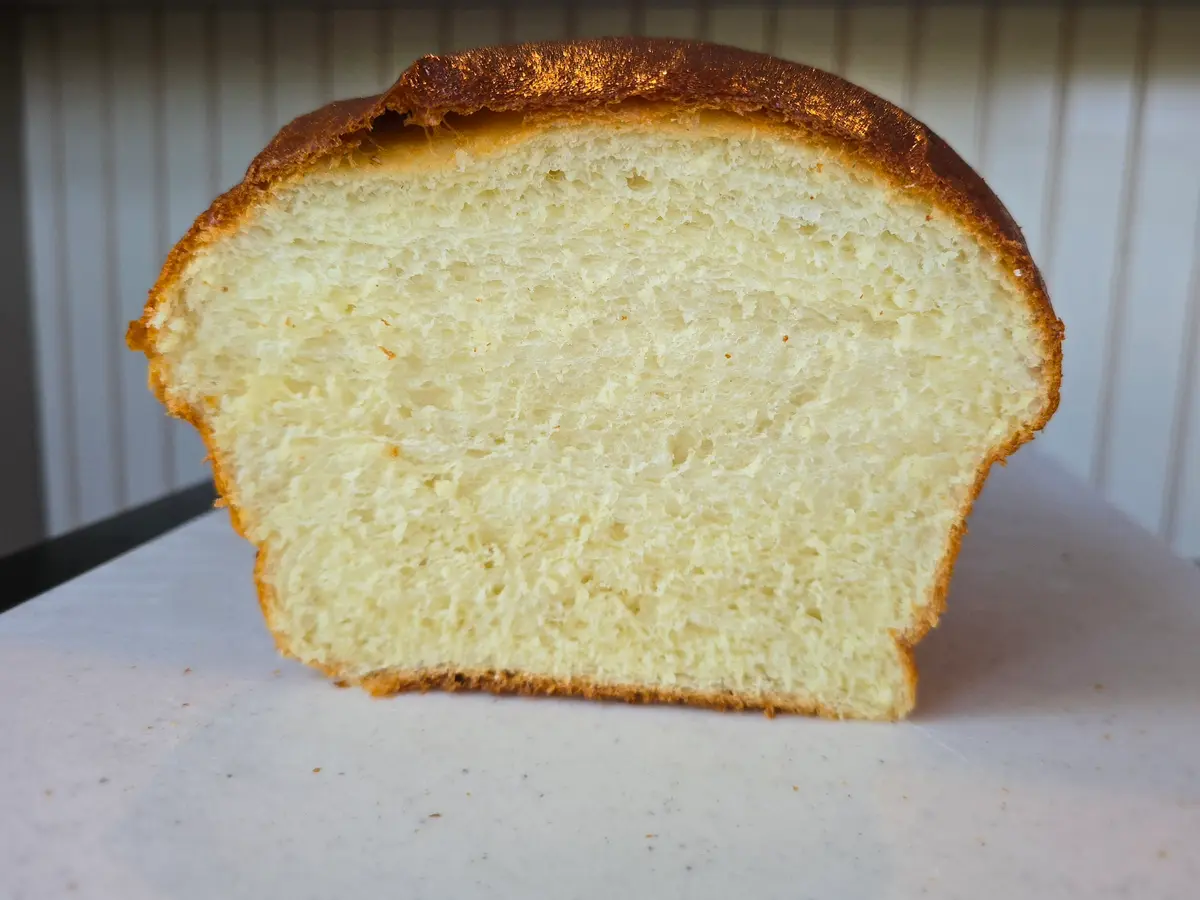
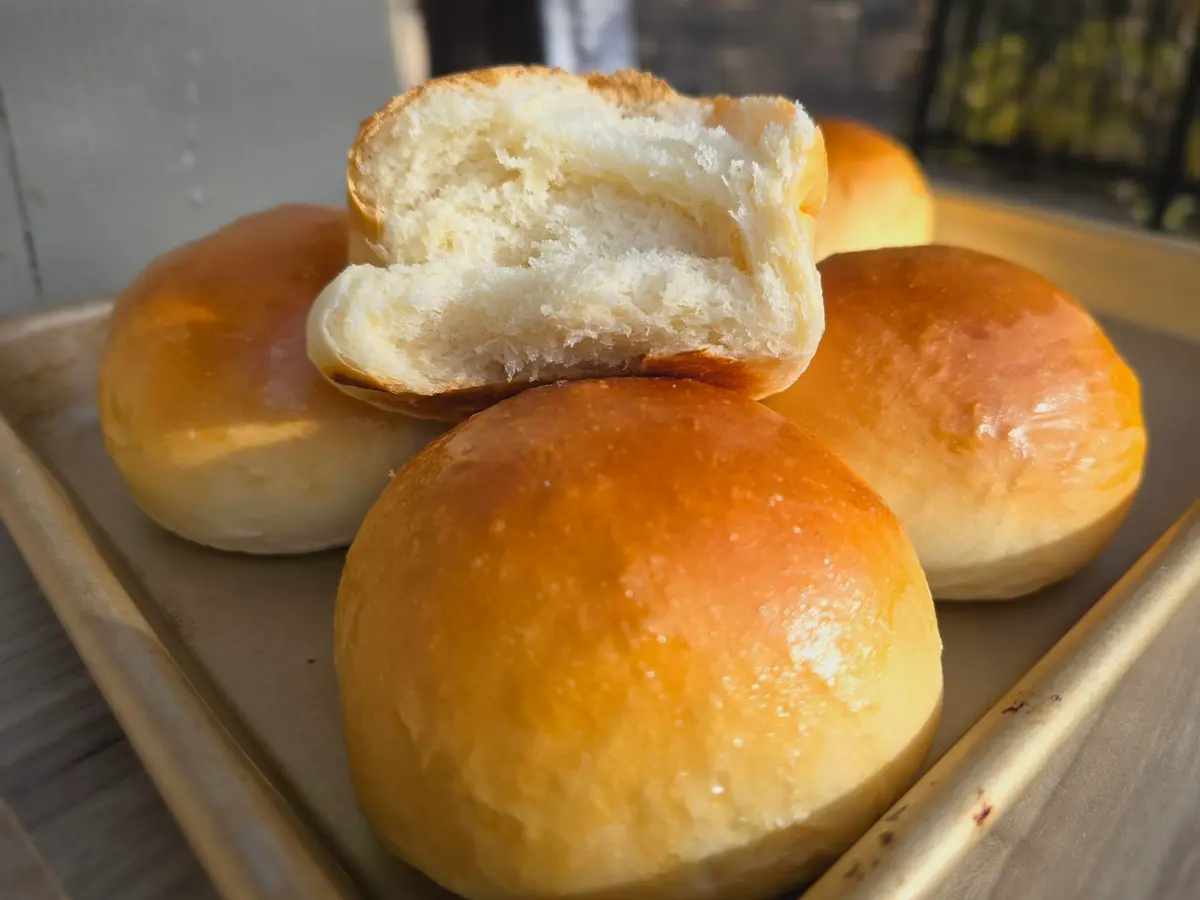
The crust comes out thin and beautifully browned, just enough to frame the softness within. The egg-and-cream wash leaves it glossy, almost polished, as though the bread has been dressed before being sent to the table. The crumb inside is pale, close, and plush, with that unmistakable pillowy quality that makes each slice feel almost weightless. It is the kind of bread that transforms the ordinary rituals of daily life. Toast becomes more elegant. Sandwiches become more deliberate. A simple swipe of butter becomes, somehow, enough.
That may be the greatest triumph of Hokkaido milk bread: it elevates the everyday without losing its humility.
This is not special-occasion bread in the traditional sense. It is not made to sit untouched in the center of the table while everyone admires it from a distance. It is made to be lived with. Toasted in the morning. Turned into sandwiches. Eaten plain in torn strips. It belongs to the intimate category of foods that become part of a household’s rhythm, and yet it carries within it extraordinary craftsmanship. That balance—between daily usefulness and technical beauty—is one of the reasons I find it so compelling.
Because in the end, this loaf is not only about softness.
It is about what it takes to create softness well.
It is about understanding dough deeply enough to make it gentle without making it weak. It is about respecting moisture as a structural element, not just an incidental one. It is about seeing bread not as something that must always be crusty, rugged, and old-world to be worthy of admiration, but as something that can be fine-textured, polished, and profoundly comforting without sacrificing seriousness.
Shokupan knows this.
It understands that tenderness is not lesser than strength. That subtlety is not lesser than drama. That a loaf can be beautiful not because it crackles, but because it yields. And once you have made a bread like this—once you have watched those smooth dough logs rise in the pan, once you have pulled from the oven a bronzed loaf with a cloud-soft interior, once you have sliced through that delicate crumb and seen how every technical decision has translated into texture—you understand that softness, too, can be a kind of mastery.
Perhaps even the most difficult kind.
Because anyone can bake bread that shouts.
This bread whispers.
And somehow, that makes it unforgettable.They're all variations of the same enriched dough, sometimes shaped differently or branded by region. This one uses my go-to method that balances texture, moisture, and clean slicing.
Ingredients
- Tangzhong Starter
- 1/4 cup (32g) bread flour
- 1/4 cup (60ml) whole milk
- 1/4 cup (60ml) water
- Dough
- 2½ cups (360g) bread flour (I use 340g to start with for softer dough; however, I tend to add more if the dough is too sticky — adjust between 340–360g as needed)
- 1/4 cup (50g) granulated sugar
- 2¼ tsp (7g) instant or quick-rise yeast
- 2 tbsp (15g) dry milk powder (full fat, optional but recommended)
- Scant 1 tsp (5g) fine salt
- 1/2 cup (120ml) whole milk, room temperature
- 1 large egg, lightly beaten
- 1/4 cup (56g) unsalted butter, softened
- For Finishing
- 1 egg + 1 tbsp (15ml) cream (for glossy egg wash)
Instructions
Tangzhong
1In a small saucepan, whisk together the flour, milk, and water until smooth. Cook over medium heat, stirring constantly until it thickens into a smooth paste (about 2–3 minutes). Let cool to room temperature.
Dough
2In a stand mixer bowl, combine the bread flour, sugar, yeast, dry milk powder, and salt. Add the cooled tangzhong, milk, and egg. Mix on low speed for 5 minutes until a shaggy dough forms.
- 3
Add the softened butter 1 tbsp (15g) at a time, mixing for 5 more minutes on medium speed (Speed 4). Continue kneading until the dough is glossy, smooth, and stretches easily without tearing — about 10–12 minutes total kneading time. If the dough is very sticky and not forming a ball, add more flour 1 tbsp (8g) at a time (up to 360g total).
- 4
Shape the dough into a ball and place it in a greased bowl. Cover tightly with plastic wrap. Place in a warmed oven (preheat to 175°F/80°C, then turn off). Let rise for 45 to 75 minutes, or until doubled and puffy.
Shaping & Second Rise
5Turn out the dough and gently press out the air. Divide into 3 equal pieces. Flatten each into a rectangle, fold the long edges towards the centre, and roll tightly into logs. Place the logs seam-side down into a greased 9x4-inch (23x10cm) loaf pan.
- 6
Cover the pan with plastic wrap and place it in a turned-off warm oven again. Let rise for 45 to 55 minutes, until the dough has domed above the rim and springs back slowly when touched.
Baking & Cooling
7Preheat the oven to 350°F (175°C). Brush the loaf gently with an egg and cream wash. Bake for 20–23 minutes, checking around 20 minutes. The internal temperature should reach at least 195°F (91°C) for a moist, perfectly baked crumb. I baked my loaf to 203°F (95°C) for about 20–21 minutes. A 195°F (91°C) internal temperature gives you maximum moistness, but 200–203°F (93–95°C) gives a loaf that's more structurally set and less prone to collapse, compressing, or becoming soggy, especially if you plan to store or slice it cleanly.
- 8
Cool the loaf in the pan for 5 minutes. Remove it and cool completely on a wire rack before slicing. Best enjoyed within 2 days or frozen for longer storage.
FAQ
Did you try this recipe?
Leave a star rating — it helps other cooks find it!
Comments
Looking for more? Explore the full collection — filter by lifestyle, cuisine, or dietary needs.